
Fundamentals
What Is a Campaign Taxonomy?
A campaign taxonomy defines what your marketing needs to measure — and turns campaign names into consistent, analytics-ready data. Here is what it is, how it works, and why it matters.
Published June 23, 2026 · Updated July 2, 2026
Key takeaways
- A campaign taxonomy defines WHAT to measure; a naming convention defines HOW to format it; the campaign name is the resulting value; governance keeps teams following both.
- Common dimensions include country, channel, platform, objective, product, audience, funnel stage, campaign type, business unit, and reporting period.
- Consistent campaign names roll up cleanly in dashboards, attribution, and Marketing Mix Modeling — inconsistent names fragment reporting into unrelated strings.
- A spreadsheet can document naming rules, but only software can enforce them with controlled values and validation before campaigns launch.
- A campaign taxonomy is usually owned by marketing operations or analytics, with defined roles, approvals, and an audit trail.
What is a campaign taxonomy?
A campaign taxonomy is the shared vocabulary a marketing organization uses to classify and name its campaigns. It defines the dimensions you report on, the allowed values for each dimension, and the order they follow — turning campaign naming from individual habit into a governed standard that works across Google Ads, Meta Ads, CRM, email, and reporting dashboards.
Common dimensions a campaign taxonomy captures include:
- Country or region
- Channel
- Platform
- Objective
- Product
- Audience
- Funnel stage
- Campaign type
- Business unit
- Reporting period
Campaign taxonomy vs. naming convention vs. campaign name
These terms are often used interchangeably, but they describe four distinct layers. Keeping them separate is what makes a taxonomy maintainable at scale.
| Layer | What it defines | Example |
|---|---|---|
| Campaign taxonomy | What to measure — the dimensions and their allowed values | Country, Objective, Channel, Product, Audience… |
| Naming convention | How to format — order, separators, casing, abbreviations | lowercase values, underscore separator, fixed order |
| Campaign name | The final value produced by applying both | cr_acquisition_paidsearch_creditcards_prospecting_google_2026q3 |
| Governance | Who can change values, plus validation and compliance | roles, approvals, real-time validation, audit trail |
A campaign taxonomy example
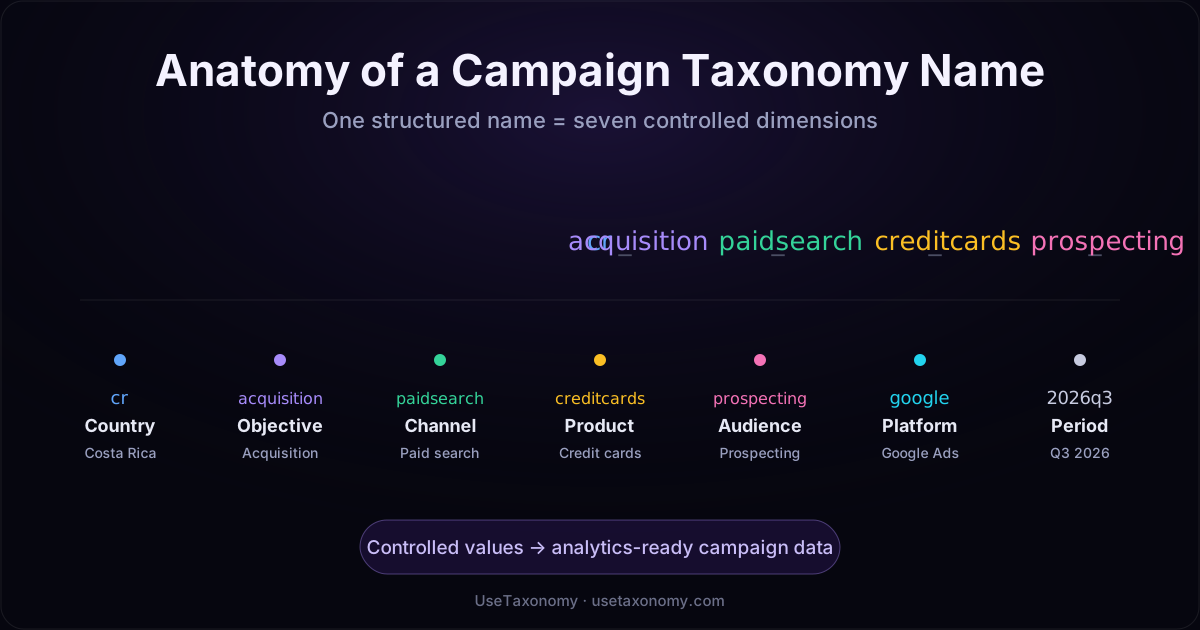
Suppose a taxonomy orders its fields Country → Objective → Channel → Product → Audience → Platform → Period, with lowercase values and an underscore separator. Applying it produces the name cr_acquisition_paidsearch_creditcards_prospecting_google_2026q3, where each segment carries a controlled dimension:
- cr — Country (Costa Rica)
- acquisition — Objective
- paidsearch — Channel
- creditcards — Product
- prospecting — Audience
- google — Platform
- 2026q3 — Reporting period
Why campaign taxonomy matters
Reporting tools group performance by campaign name and tracking values. When every campaign follows the same taxonomy, the data aggregates cleanly; when it does not, analytics platforms treat similar campaigns as unrelated strings. A governed campaign taxonomy:
- Makes performance roll up cleanly by channel, country, product, and objective
- Removes recurring manual normalization before dashboards
- Keeps campaigns comparable across markets and platforms
- Feeds attribution and Marketing Mix Modeling consistent, comparable inputs
- Speeds up onboarding — the rules are encoded, not tribal knowledge
Campaign taxonomy vs. a spreadsheet
Most teams start with a spreadsheet of naming standards. A spreadsheet is a useful reference, but it can only document the rules — it cannot prevent unapproved abbreviations, wrong field order, missing dimensions, or invalid names reaching production, and different people often work from different versions. Enforcing a taxonomy requires validation and controlled values at the moment a campaign is created.
How to build a campaign taxonomy
Building a campaign taxonomy is a repeatable process:
- Define the dimensions your organization actually reports on
- Build a controlled dictionary of allowed values for each dimension
- Set the field order, separator, and formatting rules
- Assign ownership and roles for who can add or change values
- Validate campaign names before launch — live, in bulk, or from connected accounts
- Measure compliance so you can see who follows the standard and where the gaps are
Frequently asked questions
What is a campaign taxonomy in simple terms?
A campaign taxonomy is an agreed-upon system for classifying and naming campaigns. It lists the dimensions you care about (like country, channel, objective, and product) and the allowed values for each, so every campaign is named and tagged the same way and can be compared in reporting.
What is the difference between a campaign taxonomy and a naming convention?
A campaign taxonomy defines what to measure — the dimensions and their allowed values. A naming convention defines how to format those dimensions — the order, separators, and capitalization. The campaign name is the result of applying both. Governance is the layer that keeps teams following them.
What fields should a campaign taxonomy include?
Common fields are country or region, channel, platform, objective, product, audience, funnel stage, campaign type, business unit, and reporting period. Include the dimensions you actually slice dashboards and models by — and nothing you do not use.
What is a campaign taxonomy example?
With fields ordered Country → Objective → Channel → Product → Audience → Platform → Period, lowercase values, and underscores, a campaign name becomes cr_acquisition_paidsearch_creditcards_prospecting_google_2026q3. Each segment maps to a controlled value, so the name doubles as structured metadata.
Why does a campaign taxonomy improve reporting?
Reporting groups data by campaign name and tracking values. A consistent taxonomy makes performance roll up cleanly by channel, country, product, and objective, with less manual cleanup and fewer mismatched buckets — which supports more reliable dashboards and cross-market comparisons.
Who owns the campaign taxonomy?
Ownership usually sits with marketing operations, analytics, or measurement teams, with input from paid media and regional leads. In practice it needs a clear owner per market or client, defined roles for changing values, and an approval and audit trail.
Put this into practice
Standardize and validate campaign names, UTMs, and metadata with UseTaxonomy.
Request accessCampaign taxonomy software →