
How-to
How to Name Your Marketing Campaigns
A campaign name is not just a label — it is the field your reporting groups by. Here is a step-by-step way to name campaigns so the name actually helps you later.
Published July 22, 2026
Key takeaways
- A good campaign name answers who it is for, what channel it runs on, what its objective is, and when it launched — at minimum.
- Free-text names like "New Campaign Final" or "Summer Promo v2" cannot be grouped or compared in reporting, no matter how descriptive they feel in the moment.
- Pick a fixed field order and a single separator (underscore is the safest default) and apply both every time — consistency matters more than which order you pick.
- Abbreviate from a fixed list, not on the fly — "acq" only works as a taxonomy value if everyone on the team uses the same three letters for it.
- The same naming logic should extend to ad set and ad names, and to the UTM parameters and GTM tags tied to the same campaign.
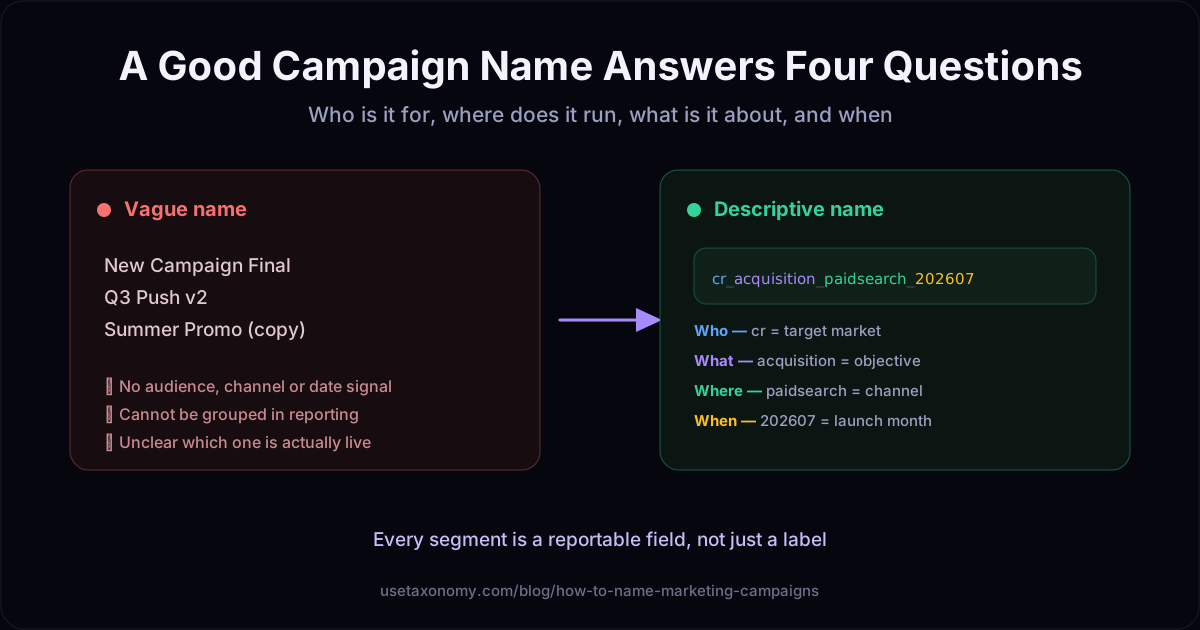
What makes a campaign name good — not just descriptive
It is tempting to think a "good" campaign name is simply one a human can read and understand. That is necessary but not sufficient. A campaign name also has to be parseable — able to be split back into its parts by a report, a dashboard, or a script — which means it needs a fixed structure, not just readable words.
A campaign name earns its keep when it answers, at minimum, four questions:
- Who is it for? — country, market, or audience segment
- What channel or platform does it run on? — paid search, social, email
- What is the objective? — acquisition, retention, awareness
- When did it launch? — a date or period, usually YYYYMM
Step-by-step: naming a campaign
Naming one campaign well is easy. Naming every campaign the same way, on a team, is the actual problem to solve. A repeatable process:
- List the dimensions you actually report on — do not include a field nobody looks at in a dashboard
- Fix the order those dimensions appear in the name, and never vary it
- Pick one separator (underscore is the safest choice — commas and slashes break in URLs and some ad platforms)
- Build a short list of allowed abbreviations per dimension, instead of typing free text each time
- Decide a case rule (all lowercase or all uppercase) and apply it everywhere
- Write the resulting name down as a template before you create the first real campaign
Campaign naming convention examples
Applying the steps above to a Costa Rica acquisition campaign on paid search, launched in July 2026:
| Approach | Example name | What is wrong with it |
|---|---|---|
| No convention | New Campaign Final | No audience, channel, objective, or date signal at all |
| Partial convention | CR Acquisition July | Readable, but not parseable — spaces and no fixed order |
| Full convention | cr_acquisition_paidsearch_202607 | Every segment is a controlled, reportable field |
Common campaign naming mistakes
- "Final", "v2", "copy", or "test" left in a live campaign name — these are not taxonomy values
- Mixing date formats across campaigns (Q3, July, 07-2026) so none of them sort or group together
- Letting each team member abbreviate objectives or products differently
- Naming the campaign well but leaving ad sets and ads free-text, breaking the structure one level down
- Documenting the convention once and never checking whether new campaigns actually follow it
Beyond the campaign name: UTMs and ad sets
A campaign name that follows a taxonomy is most useful when the same structure extends to what is downstream of it: the UTM parameters on the destination link, and the ad set and ad names inside the campaign. See our guide on
- Read more: What Is a UTM Parameter? — how utm_campaign should mirror your campaign name
Frequently asked questions
What should a campaign name include?
At minimum, the audience or market, the channel or platform, the objective, and a date. Add product, funnel stage, or business unit if your reporting actually slices by those dimensions.
What is a good campaign naming convention?
One with a fixed field order, a single separator (underscore is safest), a documented list of allowed abbreviations per field, and a consistent case rule — applied to every campaign, not just the first few.
Should I use dashes or underscores in campaign names?
Underscores are the safer default. Dashes can be ambiguous inside multi-word values, and some platforms or reporting tools treat certain characters as separators themselves, which can split a name incorrectly.
How long should a campaign name be?
As long as it needs to be to include your required fields, and no longer. Google Ads and Meta Ads both have character limits on campaign names, so an efficient set of abbreviations matters more than a naming convention that looks elegant but runs out of room.
What is a campaign name example for Google Ads?
cr_acquisition_paidsearch_creditcards_202607 — country, objective, channel, product, and launch period, each a controlled value in a fixed order.
How do I get a team to actually follow a naming convention?
Documentation alone rarely works under deadline pressure. Validating names as they are built — flagging missing fields or wrong order before a campaign launches — is what turns a written standard into one that is actually followed.
Put this into practice
Standardize and validate campaign names, UTMs, and metadata with UseTaxonomy.
Request accessCampaign taxonomy software →