
Buyer's guide
Advertising Taxonomy Tools: What to Look for
Most "naming convention" tools stop at generating a name. Here is what a full advertising taxonomy tool should actually do — and the six capabilities worth checking before you pick one.
Published July 22, 2026
Key takeaways
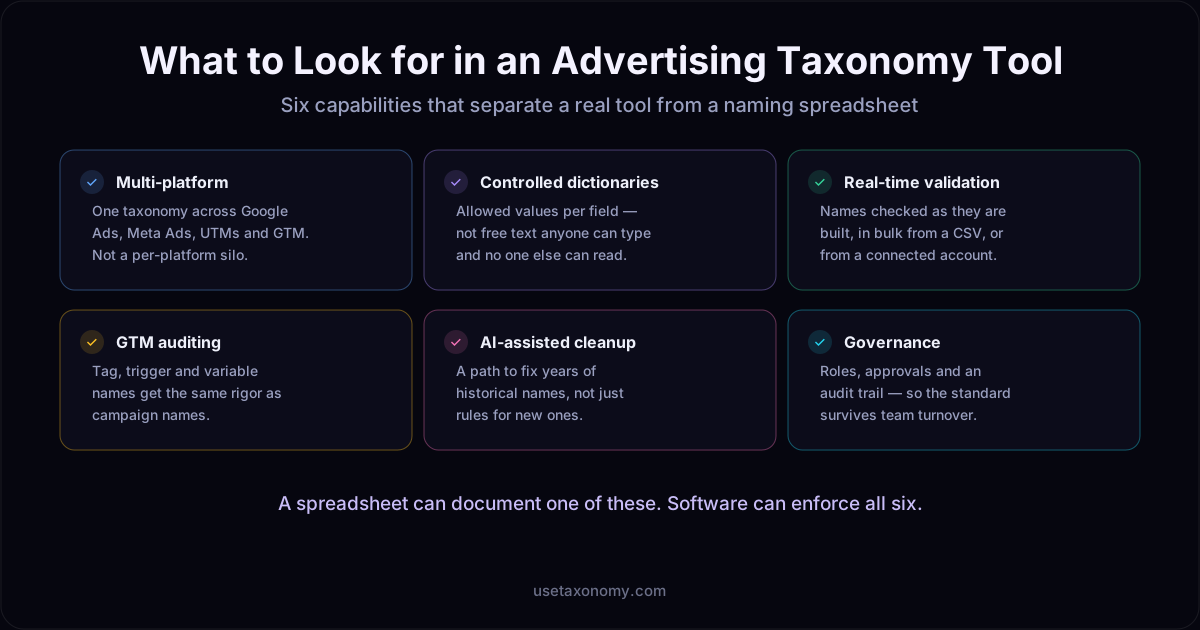
- A real advertising taxonomy tool covers six areas: multi-platform support, controlled dictionaries, real-time validation, GTM auditing, AI-assisted cleanup of historical names, and governance with roles and an audit trail.
- Most naming tools only solve for campaigns you have not created yet — they leave years of inconsistent historical names untouched.
- Tag Manager naming is a separate, often-skipped layer: GTM has no naming rules of its own, so a taxonomy tool that stops at ad platforms leaves half the tracking stack ungoverned.
- Governance (roles, approvals, an audit trail) is what keeps a taxonomy alive after the person who designed it moves teams.
What an advertising taxonomy tool should actually do
Search for "advertising taxonomy tools" and most results are either generic naming-convention generators or spreadsheet templates. Neither enforces anything — they document a standard and trust people to follow it by hand.
A tool worth adopting needs to cover the full lifecycle: defining the taxonomy, generating names from it, validating compliance, and governing how it changes over time. Six capabilities separate the two categories:
1. Multi-platform support
Campaigns run on Google Ads, Meta Ads, and often others — with UTMs and GTM tags tracking all of them. A tool scoped to a single platform forces you to maintain separate naming logic everywhere else, which is exactly the fragmentation a taxonomy is supposed to prevent.
2. Controlled dictionaries, not free text
A naming convention is only as good as the values plugged into it. Free-text fields let anyone invent a new abbreviation for "acquisition" or misspell a product code. Controlled dictionaries — a fixed, shared list of allowed values per field — are what make a taxonomy enforceable rather than aspirational.
3. Real-time validation
Names should be checked as they are built, not discovered broken in a monthly report. Validation should also work in bulk, for auditing campaigns that already exist, and ideally against a connected ad account so nothing has to be typed twice.
4. GTM auditing — the layer most tools skip
Google Tag Manager has no naming rules of its own. Tags, triggers, and variables accumulate names from whoever set them up, however they typed it that day — orphan tags, duplicate event names, and hardcoded IDs are the predictable result. See our dedicated
- Read more: GTM Audit Tool — audit and rename a container against a governed preset
5. AI-assisted cleanup of what already exists
A forward-looking naming standard does nothing for the campaigns you already have. Reclassifying years of historical names by hand does not scale — this is where AI-assisted matching against your taxonomy, with a human review step, earns its place. See
- Read more: AI Taxonomy Fixer — reclassify historical campaign names with a review queue
6. Governance: roles, approvals, and an audit trail
A taxonomy designed in a workshop and never governed afterward drifts within a quarter. Real governance means defined ownership of who can add or change values, an approval step for changes, and an audit trail showing who did what — so the standard survives team turnover, not just the launch week.
Frequently asked questions
What is the difference between a naming convention generator and a full advertising taxonomy tool?
A naming convention generator typically formats a name from fields you type in — it does not validate compliance, audit existing campaigns, or govern who can change the rules. A full advertising taxonomy tool covers definition, generation, validation, and governance together.
Do I need a separate tool for Google Tag Manager naming?
Not necessarily — but you do need a tool that treats GTM tags, triggers, and variables with the same rigor as campaign names. Many advertising taxonomy tools stop at the ad platform and leave the tag management layer completely ungoverned.
Can AI actually fix years of inconsistent campaign names?
AI can classify most historical names against a defined taxonomy with a confidence score, and should flag the ambiguous ones for manual review rather than guessing. Look for a review-and-approve workflow, not a one-click auto-rename — the latter is where mistakes compound.
Is a spreadsheet ever good enough?
A spreadsheet is a fine starting reference for documenting rules. It becomes insufficient the moment more than one person creates campaigns, because it cannot prevent invalid names, enforce controlled values, or show who changed what.
What should I check first when evaluating a taxonomy tool?
Start with whether it validates in real time and supports every platform you actually use — Google Ads, Meta Ads, UTMs, and GTM. A tool that is strong on one platform but ignores the others will just move the inconsistency somewhere else.
Put this into practice
Standardize and validate campaign names, UTMs, and metadata with UseTaxonomy.
Request accessCampaign taxonomy software →