
Fundamentals
What Is Marketing Data Governance?
General data governance covers the whole enterprise. Marketing data governance is narrower and more actionable: the rules that keep campaign, channel, and audience data trustworthy.
Published July 6, 2026
Key takeaways
- Marketing data governance is a focused application of general data governance: same principles (ownership, standards, quality, access), narrower scope (campaign, channel, and audience data instead of the entire enterprise data estate).
- It is usually owned by marketing operations or analytics teams, not solely by IT or a central data platform team — because marketing data changes with every campaign launch.
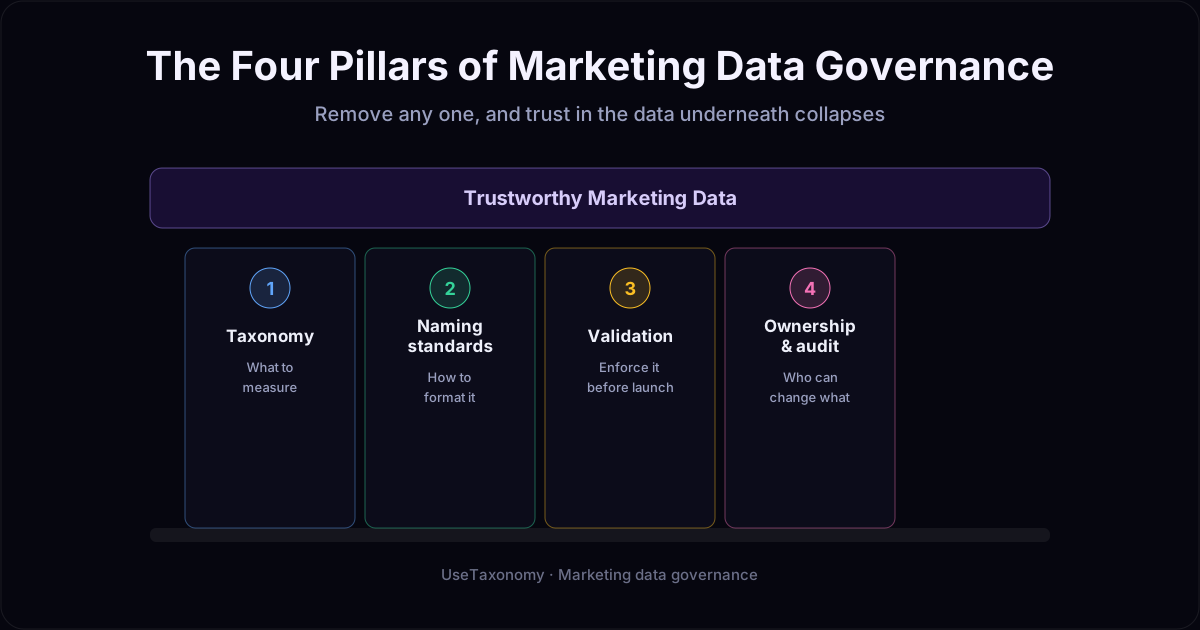
- It rests on four pillars: a taxonomy (what to measure), naming standards (how to format it), validation (enforcing it before launch), and ownership with an audit trail (who can change what).
- Without it, the same failure mode repeats: campaign data looks fine at launch, then fragments the moment someone tries to build a dashboard or feed a model with it.
- Marketing data governance is what makes campaign data reliable enough to feed attribution, Marketing Mix Modeling, and AI-assisted workflows.
What is marketing data governance?
Marketing data governance is the practice of defining, standardizing, and enforcing the rules that keep marketing data trustworthy — specifically the data generated by running campaigns: campaign names, UTM parameters, audience and segment definitions, and the metadata attached to channels, products, and objectives.
It borrows its core principles from general data governance — ownership, standards, quality control, access — but applies them to a narrower, faster-moving domain: data that gets created every time a campaign launches, not data that lives in a static warehouse schema.
Marketing data governance vs. general data governance
The two disciplines overlap but are not the same practice, and conflating them is a common reason marketing data governance stalls inside a broader data-governance initiative:
| General data governance | Marketing data governance | |
|---|---|---|
| Scope | The entire enterprise data estate | Campaign, channel, and audience data specifically |
| Typical owner | IT or a central data platform team | Marketing operations or analytics |
| Primary artifacts | Data catalogs, schemas, access policies | Taxonomy, naming convention, validation rules |
| Pace of change | Changes with system or schema updates | Changes with every new campaign, market, or product |
Why marketing teams need their own governance practice
Marketing data has characteristics that a general enterprise data-governance program rarely addresses well:
- New values (campaigns, products, audiences) are created constantly, not just at schema design time
- The people creating the data are marketers and agencies, not database administrators
- Reporting depends on campaign names and UTMs matching exactly, not just on a table schema being correct
- Multiple platforms (Google Ads, Meta Ads, GTM, CRM) each generate their own version of the same campaign metadata
The four pillars of marketing data governance
A workable marketing data governance practice rests on four pillars, each answering a different question:
- Taxonomy — what dimensions does the organization need to measure? (country, channel, objective, product, audience…)
- Naming standards — how are those dimensions formatted into a name? (field order, separators, casing)
- Validation — is a given campaign name or UTM actually compliant before it goes live?
- Ownership & audit — who can add or change allowed values, and is there a record of who did?
Signs your marketing data governance is missing
These symptoms usually show up long before anyone calls the problem "governance":
- Every dashboard refresh starts with someone cleaning up campaign names in a spreadsheet
- The same channel or product appears under three or four different spellings in reports
- No one can say with confidence who is allowed to add a new campaign objective or product code
- Marketing Mix Modeling or attribution projects stall on data preparation before any modeling starts
- Agencies and regional teams each use a different naming pattern for "the same" campaign type
How to start a marketing data governance practice
A practical starting sequence, in order:
- Define the taxonomy: the dimensions your reporting actually needs, and the allowed values for each
- Document the naming convention: field order, separator, casing, and formatting rules
- Assign ownership: who approves new values, and who is accountable per market or client
- Validate at the point of creation, not after the fact — live, in bulk, or from connected ad accounts
- Measure compliance so gaps are visible before they reach a dashboard
Frequently asked questions
What is marketing data governance in simple terms?
It is the set of rules and ownership that keep campaign, channel, and audience data consistent — so campaign names and UTMs mean the same thing every time they appear, across every platform and every team.
Why is data governance important in marketing specifically?
Marketing generates new data constantly (every campaign, every launch), through many hands (marketers, agencies, freelancers) and many platforms. Without governance, that volume and variety turns into naming inconsistency fast, which breaks reporting, attribution, and modeling.
What is a marketing data governance framework?
A marketing data governance framework is the structured combination of a taxonomy (what to measure), a naming convention (how to format it), validation (enforcement), and ownership with an audit trail (accountability) — the four pillars that keep the practice operational rather than aspirational.
What are the four pillars of a data governance framework, applied to marketing?
For marketing data specifically: taxonomy (the dimensions and allowed values), naming standards (format and structure), validation (checking compliance before launch), and ownership and audit (who can change values, and a record of changes).
How is marketing data governance different from general data governance?
General data governance typically covers the full enterprise data estate and is owned by IT or a data platform team. Marketing data governance is narrower in scope (campaign, channel, and audience data) and is usually owned by marketing operations or analytics, because the data changes with every campaign rather than with schema updates.
Who owns marketing data governance?
Ownership typically sits with marketing operations, analytics, or measurement teams, with input from paid media and regional leads — the people closest to how campaigns are actually created and reported on.
Put this into practice
Standardize and validate campaign names, UTMs, and metadata with UseTaxonomy.
Request accessCampaign taxonomy software →