
Fundamentals
Job Title Taxonomy: Classifying Roles by Business Function
CEO, VP Marketing, Head of Marketing, Enterprise Account Executive — which category do they belong to? A job title taxonomy answers that consistently, every time.
Published July 6, 2026
Key takeaways
- A job title taxonomy groups job titles into a fixed set of categories (e.g., Executive Leadership, Marketing, Sales, Customer Success, Product & Engineering) instead of treating every title as unique free text.
- The same title is often worded differently across companies — "Head of Marketing," "VP Marketing," and "CMO" usually belong in the same category.
- This classification supports audience segmentation, ABM targeting, lead scoring, and CRM data quality — the same outcomes a campaign taxonomy delivers for campaign data.
- Edge cases (hybrid titles, regional naming differences, seniority ambiguity) need an owner and a documented rule, not a one-off decision.
- The underlying discipline — controlled categories, applied consistently — is the same one that governs campaign names, UTMs, and other marketing metadata.
What is a job title taxonomy?
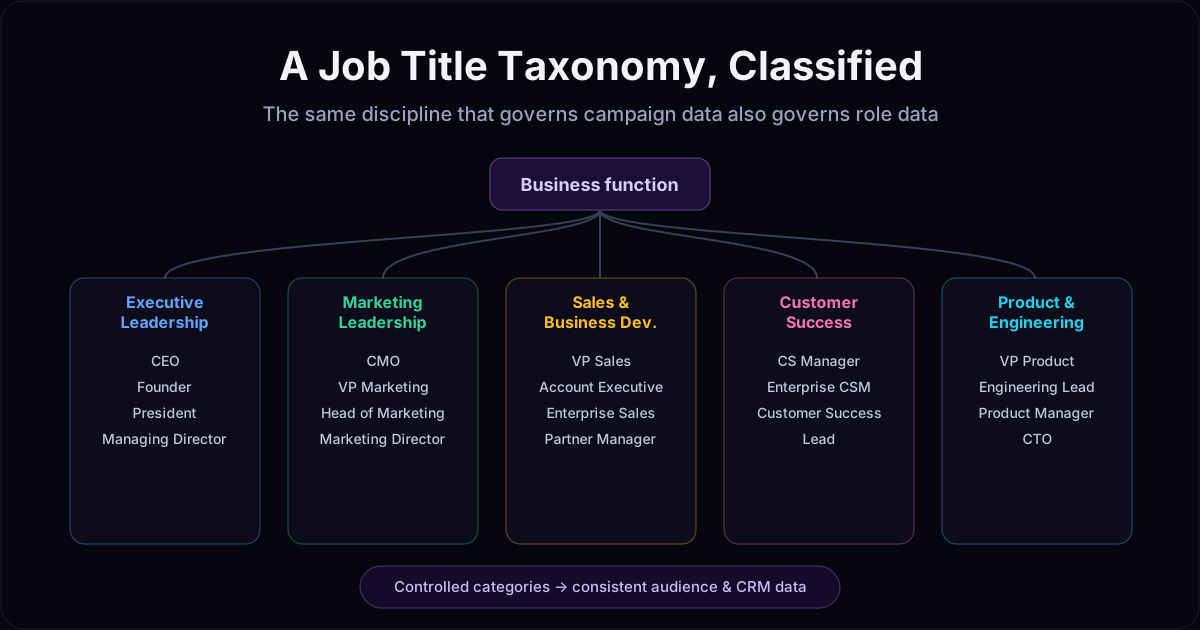
A job title taxonomy is a controlled set of business function categories that every job title in your audience, CRM, or lead data gets mapped to. Instead of treating "VP Marketing," "Head of Marketing," and "Marketing Director" as three unrelated values, a taxonomy recognizes that they describe the same function and classifies them the same way.
This matters most in B2B marketing and sales, where the same role is worded differently company to company, and lists need to be segmented or scored by function and seniority regardless of the exact wording.
Why classify job titles at all?
A governed job title taxonomy supports several everyday marketing and sales workflows:
- Audience segmentation and ABM targeting by function and seniority
- Lead scoring rules that key off role category, not exact title text
- CRM and marketing-automation data cleanup and deduplication
- Reporting on pipeline or engagement by business function
- Consistent enrichment when titles are sourced from multiple tools
Common business function categories
Most B2B job title taxonomies converge on a similar set of top-level categories:
| Category | Example titles |
|---|---|
| Executive Leadership | CEO, Founder, President, Managing Director |
| Marketing | CMO, VP Marketing, Head of Marketing, Marketing Director |
| Sales & Business Development | VP Sales, Account Executive, Enterprise Sales, Partner Manager |
| Customer Success | Customer Success Manager, Enterprise CSM, CS Lead |
| Product & Engineering | CTO, VP Product, Engineering Lead, Product Manager |
| IT & Data | CIO, VP IT, Data Analytics Lead |
A worked classification example
Applying the categories above to a handful of real-world titles looks like this: a "Head of Marketing" or "VP Marketing" maps to Marketing; an "Enterprise Account Executive" maps to Sales & Business Development; a "Customer Success Manager, Enterprise" maps to Customer Success; and a "Founder" or "CEO" maps to Executive Leadership — even though none of those source titles use the category name itself.
The classification rule is what makes this repeatable: define the category boundaries once, then apply them consistently as new titles appear in your data.
Handling edge cases
Some titles genuinely span two functions — a "VP Marketing & Business Development" or a "Chief Commercial Officer" blending sales and marketing leadership. A governed taxonomy documents a rule for these cases (for example, classify by the first listed function, or by the team the person actually leads) instead of leaving each analyst to decide independently. Without a documented rule and an owner, the same hybrid title gets classified differently every time it is encountered — which is the same failure mode that breaks campaign naming without governance.
Job title taxonomy vs. campaign taxonomy
A job title taxonomy classifies people; a campaign taxonomy classifies campaigns. But the underlying discipline is identical: define the categories, build a controlled dictionary of allowed values, apply the mapping consistently, and govern who can add new values as the business evolves.
If your team already maintains a role taxonomy for audience data, applying that same rigor to campaign names, UTMs, and channel metadata is exactly what campaign taxonomy governance covers.
Frequently asked questions
Which category does a Customer Success Manager belong to in a business function taxonomy?
A Customer Success Manager — including enterprise-focused variants like "Enterprise CSM" — is typically classified under the Customer Success category, separate from Sales and from Marketing, since the function centers on post-sale retention and account health rather than acquisition.
Where does a VP of Marketing fit in a business function taxonomy?
A VP of Marketing, along with titles like "Head of Marketing," "CMO," and "Marketing Director," is classified under the Marketing category. Seniority (VP vs. Director vs. Head) can be tracked as a separate dimension from the function category itself.
What category does a Founder or CEO map to in a taxonomy?
Founder and CEO titles are generally classified under Executive Leadership, alongside President and Managing Director, since these roles represent overall organizational leadership rather than a specific functional area like marketing or sales.
How do you map an Enterprise Account Executive to a category taxonomy?
An Enterprise Account Executive maps to Sales & Business Development, the same category as VP Sales and Partner Manager, since the role is centered on new business acquisition rather than post-sale support.
What is the difference between marketing and data analytics in a job function taxonomy?
Marketing job functions cover roles focused on campaigns, brand, and demand generation, while data analytics functions cover roles focused on measurement, reporting, and data infrastructure. A title like "Marketing Analyst" can sit in either category depending on whether the taxonomy prioritizes the department (Marketing) or the function performed (Analytics) — this is exactly the kind of rule a taxonomy should document explicitly.
How do you build a job title taxonomy?
Start by listing the business function categories your reporting actually needs (commonly Executive, Marketing, Sales, Customer Success, Product, and IT/Data). Then build a mapping table from known titles to categories, document a rule for hybrid or ambiguous titles, assign an owner, and revisit the mapping as new titles appear in your data.
Put this into practice
Standardize and validate campaign names, UTMs, and metadata with UseTaxonomy.
Request accessCampaign taxonomy software →